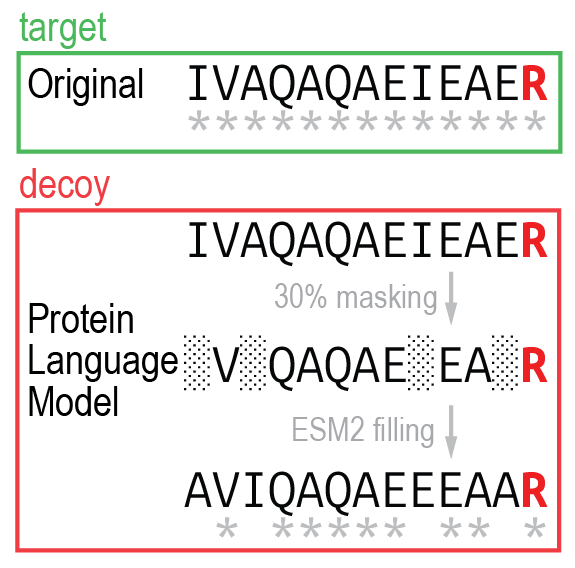
Our paper on Protein Language Model (PLM) decoys is now out in the Journal of Proteome Research.
Most proteomics pipelines estimate false discovery rates with target–decoy competition, and most of them build decoys by reversing or shuffling target peptides. Those decoys don’t look much like real peptides. So we tried to make better ones - mask part of each target sequence (30% of residues in the figure above) and let the ESM2 model fill in the gaps.
Realism turned out to matter less than we expected. How natural a decoy looks at the sequence level says little about how well it works for FDR estimation, and short peptides collide with their targets no matter which generator you use. Reversed decoys are still a strong baseline.
PLM decoys are useful anyway. Since you choose how much of each peptide gets rewritten, they are tunable, which makes them good tools for benchmarking and stress testing. We also describe a three-layer quality-control framework that you can run on any decoy strategy.
The work was done by Grigory Reznikov, Fabrice Kusters (BSc student from TU Eindhoven), Majid Mohammadi and Henk van den Toorn.